The Fire That Lives Within
Apr 20, 2026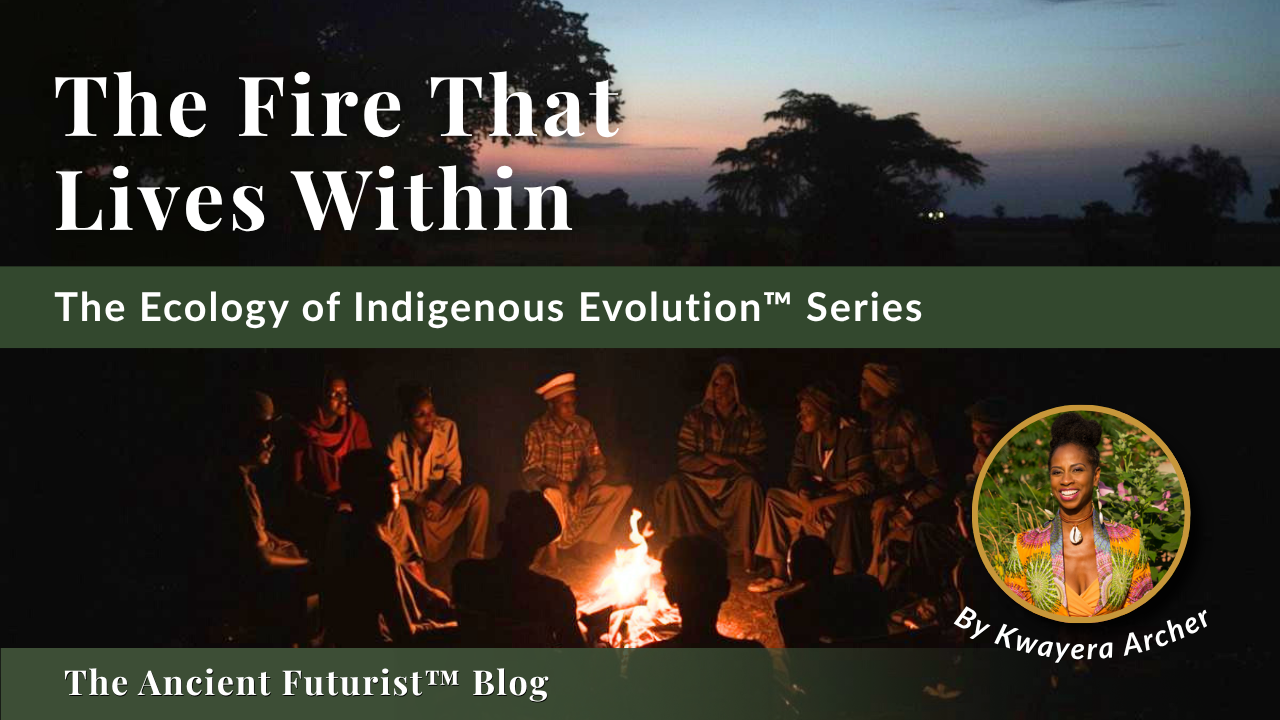
Over the years, leading retreats and Mbongi circles across the world, I’ve come to know fire as more than heat or light. It has become a steady presence, one that mirrors our humanity. I remember evenings when the group gathered quietly around the flames, and something unspoken in each person began to loosen, like the body finally exhaling after holding too much for too long. Fire does not rush us. It waits, offering light enough to see ourselves clearly, warmth enough to stay present, and movement enough to keep us awake to transformation.
The Fire Inside the Body
Modern science reveals that fire lives within us in more ways than poetry once imagined. The food we eat becomes fuel, converted through metabolism into energy; heat that sustains our lives at a near-constant temperature of 98.6°F (37°C). A candle may burn at over 2,000°F (≈1,100°C), yet our internal flame remains measured and life-sustaining. Inside every cell, the mitochondria act as micro-hearths, transforming oxygen and nutrients into energy through oxidative phosphorylation, a controlled form of combustion. The same chemical miracle that fuels a flame also fuels us.
This process is governed by the hypothalamus, the brain’s thermostat. It regulates the delicate balance between heat production and release. When the body is under stress, the sympathetic nervous system ignites, raising heart rate, body temperature, and alertness. When we breathe deeply, the vagus nerve signals the parasympathetic system to restore calm, cooling the fire from within. This cyclical dance: burn, rest, renew, mirrors the natural rhythm of the flame.
The body even carries a specialized heat generator: brown adipose tissue, or brown fat. It produces warmth through non-shivering thermogenesis, a cellular process that keeps infants alive and continues to function subtly in adults. This gentle combustion, this quiet, continuous fire, reminds us that we are each living evidence of elemental balance.
The Fire of Spirit and Soul
Long before science described mitochondria or thermoregulation, Indigenous and ancient traditions recognized fire as sacred energy.
- In Yoruba cosmology, Ṣàngó carries lightning, embodying both justice and vitality—the surge that destroys and renews.
- In Kongo wisdom, Moyo wa moto (“the fire of life”) speaks to the soul’s energetic core.
- In Hindu tradition, Agni is both digestive and spiritual fire, bridging body and divinity.
- In Chinese medicine, Shen is the fire of the heart—the light of the soul.
- In Egyptian cosmology, the ka is one’s life-heat, animating force, and eternal spark.
- In Māori belief, ahi kā (“the fire that stays burning”) symbolizes ancestral continuity and guardianship of the land.
- In Shinto Japan, the hi-matsuri purification festivals celebrate flame as a living bridge between humanity and kami, or spirit.
Each tradition recognizes what physiology confirms: without steady heat, there is no life; without soul-fire, there is no direction.
Fire in the Mbongi: Communal Heat and Healing
In the Mbongi circles I’ve guided at retreats from Ghana to Jamaica, fire sits at the center, not as decoration, but as participant. It listens. It absorbs. I’ve watched people pour grief, anger, or silence into its light, each exhale softening into the shared breath of the group. Some sing; others sit wordless until their bodies begin to sway with the rhythm of the flame. The fire receives it all without judgment.
At one Soulful Joy Retreat, the night air thick with salt and memory, I watched as tears turned to laughter and the circle’s collective body exhaled. It was not spectacle, it was restoration. Fire does not perform; it transforms.
Ancestral Fire: The First Soulful Joy Retreat, Negril, 2020
One of the most unforgettable fires I have ever tended was in Negril, Jamaica, during our first Soulful Joy Retreat in 2020, a moment when the whole world was holding its breath. Travel was uncertain, yet we gathered carefully, drawn by a need to reconnect to spirit and to one another. That afternoon, the sea wind met the flame like an old friend. The wood was stacked in the traditional triangular “teepee” shape long used across Jamaica, its form echoing ancestral geometries that appear throughout the Caribbean.
Though written records are limited, we know that the Taino peoples (indigenous to the Caribbean and once spanning Jamaica, Hispaniola, Puerto Rico, and Cuba) honored fire as an element of vitality and sacred continuity. In their Areitos, the great ceremonial gatherings of song, dance, and offering, fire was present as witness and portal. Contemporary Taino revivalists in Puerto Rico continue these rites, rekindling ancestral fires at Jayuya and other sacred sites. I often feel this same memory move through me, as if the act of tending flame awakens something encoded in my own bloodlines.
On that final day in Negril, we stood barefoot on the sand around the fire, the smell of salt and cedar rising between us. It was a closing fire—a purification before return. One by one, participants stepped forward to release what they chose to no longer carry and decided to release: grief, fear, exhaustion, the ache of isolation. The fire answered with small bursts of orange light, each spark a quiet prayer. I felt, in that moment, that I was not simply recreating a ritual, but remembering one—that the Taino memory of sacred flame, intertwined with my Maroon heritage of resilience and liberation, was pulsing through me. When the last ember dimmed, we knew something in us had recalibrated. It was the same lesson every circle teaches: when we gather around flame with honesty, we are never the same again.
Pele and the Earth’s Fire
In Hawaiian cosmology, Pele, goddess of volcano and renewal, embodies the generative face of flame. When her lava meets the ocean, new land is born. The molten rock averages 2,140°F (1,170°C), nearly a thousand degrees hotter than a candle flame, yet it carries the same principle: intense heat as creation’s pulse. When it cools, it becomes volcanic soil, some of the most fertile on earth. From such scorched beginnings, forests thrive. Fire is not only the end of things, it is also the beginning of fertility.
The Inner Flame of Leadership and Balance
Fire within the body is both physiological and moral; it asks for stewardship. Leadership, too, has a temperature. The same inner heat that drives us can, when untended, become burnout or impatience. The hypothalamus teaches us that balance is the key: too much fire consumes, too little stifles life. In leadership practice, tending our flame means regulating our energy, remaining clear, and refusing to let intensity override integrity.
In every Mbongi, the firekeeper plays this role: turning the wood, feeding air to the coals, keeping the flame alive without letting it rage. It is a communal metaphor for self-regulation, for leadership that radiates warmth but never burns those it guides.
Tending the Flame Beyond the Circle
Long after retreats end and circles close, I continue to light a single soy candle each evening. Its glow recalls every voice and silence reflected in the firelight. The same warmth that lives in that flame lives in us: quiet, luminous, and creative. To tend it is to practice balance: to feed what gives life, to calm what could destroy, to remember that renewal begins in heat before it takes form.
This is the fire that lives within: ancient, disciplined, regenerative, alive.
© 2026 Kwayera Archer, Global Ase Enterprises. All Rights Reserved.
This essay is part of the Ecology of Indigenous Evolution™ series by Kwayera Archer.
The Ancient Futurist is the home of Kwayera Archer’s work.
A living body of teachings exploring leadership, memory, land, and the unseen threads shaping our lives.
This is not content designed for speed.
It is work meant to be returned to.
Stay close to the work.
Receive monthly reflections, new writings, and quiet invitations to go deeper.
We will never sell your information, for any reason.
